
Malta hosts approximately 78% of its national public-sector digital services on Amazon, Microsoft, or Google cloud. Singapore hosts 76%, and Finland 56%; Germany hosts 3%, and South Korea 1%. Two new papers from the GEOCLOUD project give the first global estimates of how far governments depend on US hyperscalers, covering 23,876 national-level public-sector services in 158 countries. The most dependent states are not the poorest: they are small and rich.
Key findings
- US cloud’s share of public-sector hosting runs from 0% (China) to 81% (Bahrain). The median country is at 4%.
- Higher-income countries host on average 21% of services on US cloud; lower-income countries host 6%.
- Among higher-income countries, smaller states depend more. A domestic alternative appears more feasible above roughly 50 million people or USD 2 trillion GDP.
Who hosts the state?
“If Americans decide to shut down cloud services at 8am, Denmark will be at a standstill by 9am,” said the chair of Denmark’s Cybersecurity Council as Washington renewed its claims on Greenland in 2025. At the same time, US sanctions cut judges and prosecutors at the International Criminal Court off from Microsoft and Amazon services. A foreign “kill switch” on government IT is no longer hypothetical.
Yet governments rarely disclose where their digital services are hosted. Until now, we had few means to assess how dependent one government is compared to another.
The new data
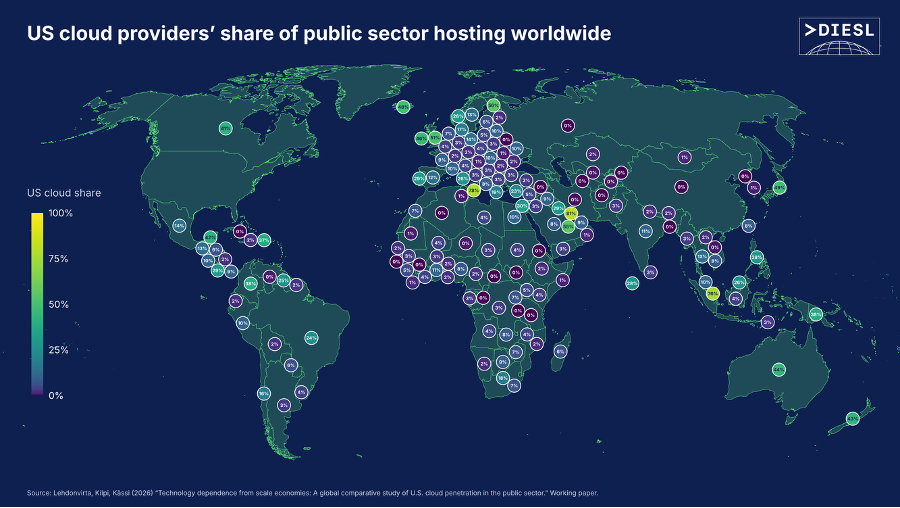
According to our new data, the variation in governments’ reliance on US cloud is wide. Bahrain (81%), Malta (78%), and Singapore (76%) host most of their national-level public-sector services on US cloud. China and several lower-income countries host none. Most countries sit at the low end; a minority have outsourced most of their public digital estate to Big Tech.
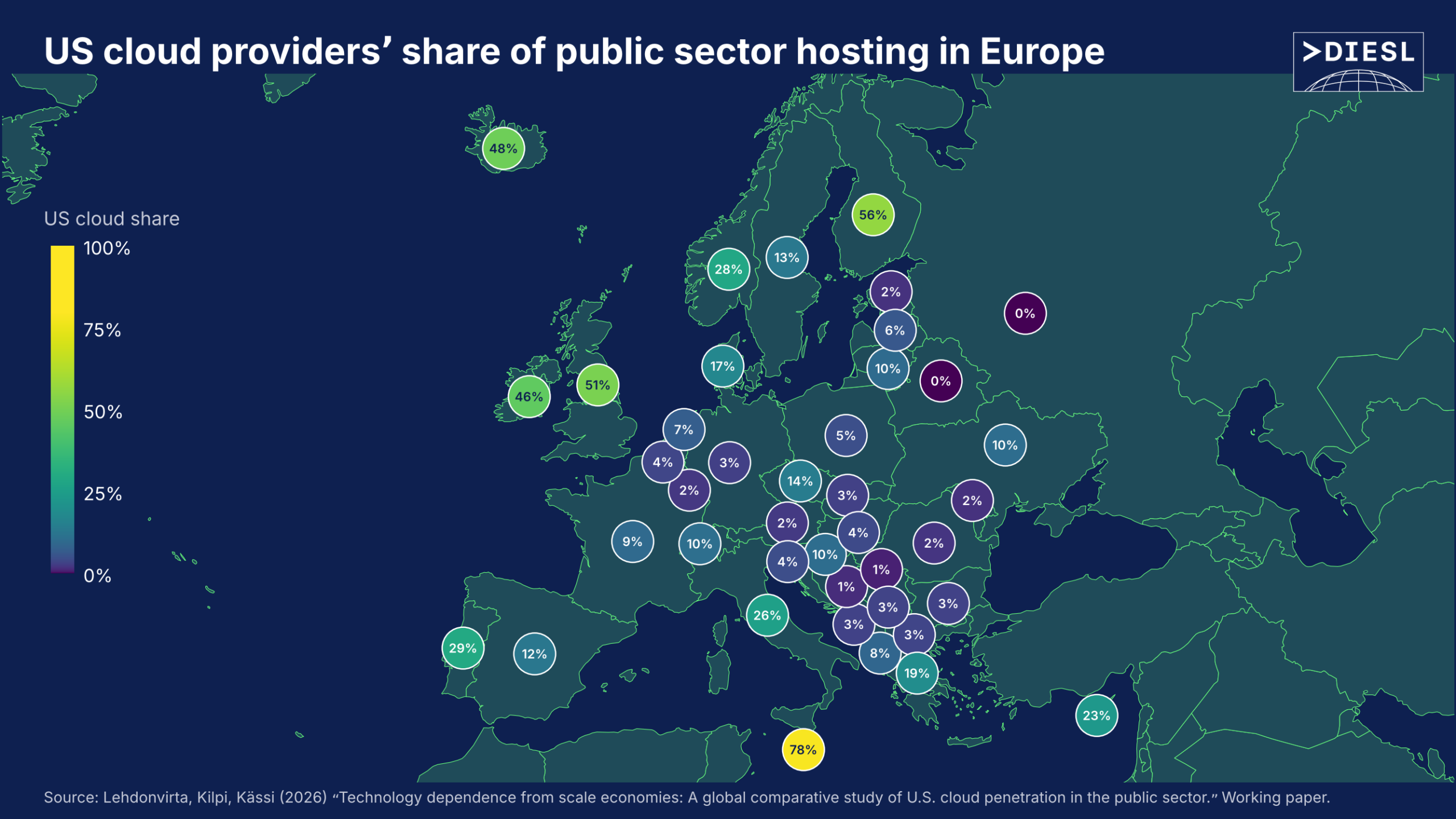
There is wide variation between European countries as well. The UK hosts an estimated 51% of its services on US cloud, Iceland 48%, and Ireland 46%, against 9% for France and only 3% for Germany. Variation is large even among the Nordic countries: Finland is at 56%, Norway 28%, Denmark 17%, and Sweden 13%.
Many of the services hosted on AWS, Azure, or Google Cloud are core functions of the state. In Iceland, they appear to include the central government portal, the police, immigration, social benefits, the electoral commission’s information portal, and the emergency number portal. In Singapore, they include the tax portal, the Supreme Court, and the websites of the security services.
How we measured it
E-government hosting arrangements cannot be observed directly. In a study just published in Government Information Quarterly titled “Detecting Digital Dependence”, we introduce a new methodology for inferring hosting arrangements from public Internet infrastructure records. Together with Godofredo Ramizo, we first built a verified ground truth data set for 269 public-sector services, mainly through Freedom of Information requests to public sector agencies in the UK, Finland, and the Philippines. A machine-learning classifier was then trained on the ground truth to identify US hyperscaler hosting from fingerprints such as name servers, mail servers, autonomous system names, and TLS certificate issuers. The classifier achieves 83% accuracy.
In another new study, “A global comparative study of U.S. cloud penetration in the public sector”, released as an online working paper, we then apply this new methodology to 23,876 public sector domains across 158 countries. This way we are able to produce an estimate of what share of national-level public-sector domains in each country is hosted on US cloud. The domains were collated by an AI agent following rules refined in large pilots carried out with research assistants. The two papers mark a milestone in work that began several years ago with the first small pilots of the method.
Why small, rich states?
Classic dependency theory expects poor countries to be more dependent. For cloud, the pattern is reversed: statisticaly analysis of the data reveals that small, rich countries are the most dependent. We argue that there are two structural reasons for this.
The first reason is labour cost. Low-income countries can run government IT on labour-intensive, lower-tech arrangements such as on-prem web server hosting. But high-wage countries depend on labour-saving high-tech solutions such as cloud to reduce manual workloads and keep public sector productivity up.
The second reason is scale. Cloud infrastructure has very strong economies of scale and scope. A small home market cannot sustain a domestic provider that competes with AWS, Azure, or Google. Larger rich countries are better able to sustain domestic alternatives: France and South Korea both have substantial domestic cloud industries that are at least locally competitive.
Small rich states face both constraints at once. This explains the cluster at the top: Malta, Singapore, Bahrain, Finland, and Iceland. However, while larger rich countries have more capacity to develop domestic alternatives, they do not always choose to use it. The UK (51%) and Japan (49%) chose to adopt cloud-first procurement policies that in practice handed over their public sector hosting markets to US hyperscalers. While the structural factors identified in our study condition countries’ choices, they also leave room for political agency.
What this means for policy
The scale-or-labour model points to three policy levers that countries can in principle use to reduce their dependence: protecting domestic providers, subsidising them, or pooling demand with other countries. For instance, South Korea effectively shut AWS and Azure out of public sector hosting in 2016. Now their domestic cloud providers not only dominate the local public sector market but are also competitive in the regional East/Southeast Asian market.
However, the smaller a country is, the more expensive the protections or subsidies sufficient to overcome the home market size gap. In many cases pooling demand with other small countries to constitute a large market collectively might thus be more economically viable. In principle, forming a large integrated market is the EU’s core mandate. However, cloud procurement still fragments very much along national lines.
The EU Commission’s Cloud and AI Development Act proposes to create a common framework for public sector cloud procurement and to exclude US providers from more critical services. However, member states’ positions diverge: larger member states whose domestic providers would benefit from such exclusions push for strengthening them, while smaller member states that currenly use US cloud would face a huge migration cost and thus oppose exclusions.
Luxembourg, with a population of just 630,000, is a rare example of a small state whose public sector digital services reveal next to no US cloud hosting dependence. The state has actively developed a sovereign data centre industry since at least 2006, both as investor and as anchor customer. The country is also home to a large financial and corporate services sector that generates large-scale demand for “sovereign grade” domestic hosting services.
Caveats
- We measure the number of services, not how critical each one is.
- We measure national-level services only; local government services may well be more cloud-dependent.
- The measure is weaker in lower-income countries, where governments often rely on US platforms such as Facebook rather than on cloud hosting.
- The classifier can miss US providers that operate through local intermediaries.
- Web-facing service hosting is one slice of the technology stack, albeit a critical one. Productivity software, email, AI models, and chips are separate dependencies.
Vili Lehdonvirta is Professor of Technology Policy at the Department of Computer Science, Aalto University, and Senior Fellow at the Oxford Internet Institute. He leads the Digital Economic Security Lab DIESL.
Otto Kässi is a Research Fellow at the Department of Computer Science, Aalto University, and an economist at Etla Economic Research.
Jaakko Kilpi is a doctoral researcher at Aalto University who uses computational methods to study how states depend on foreign cloud infrastructure.
Papers
- Kilpi, J., Kässi, O., Ramizo Jr., G., and Lehdonvirta, V. (2026). “Detecting Digital Dependence: Inferring Government Use of Hyperscale Cloud from Internet Infrastructure Data.” Government Information Quarterly. https://doi.org/10.1016/j.giq.2026.102194
- Lehdonvirta, V., Kilpi, J., and Kässi, O. (2026). “Technology dependence from scale economies: A global comparative study of U.S. cloud penetration in the public sector.” Working paper. https://doi.org/10.5281/zenodo.24380536
In the media
- Politico: “Study shows stark differences in how much EU countries depend on US Big Tech”, 26 November 2026.