
Vili Lehdonvirta
Recent reporting indicates that Iranian drone strikes damaged Amazon Web Services data centres in the United Arab Emirates and Bahrain, causing disruption to millions of people and businesses in the Gulf region. Iranian state media claims that the data centres were deliberately targeted.
This appears to be the first time a country’s armed forces attacked commercial data centres in another country. Why did data centres become targets in military conflict? And what does a geopolitical perspective reveal about the likely consequences of the attacks for future investment in the region?
Dual-use data infrastructures
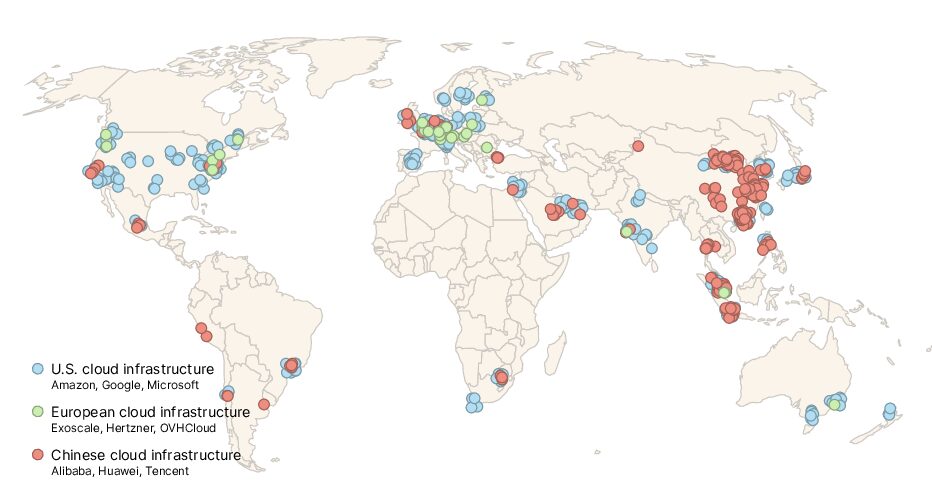
The Persian Gulf region has in recent years emerged as a particular hotspot for hyperscale cloud and AI data centres. The region hosts not only U.S. tech firms’ facilities but also the facilities of their Chinese rivals Alibaba, Huawei, and Tencent.
Security researchers have for some time expected data centres anywhere to become potential targets of physical attack. One reason is the massive concentration of data and workloads from numerous firms and public-sector organisations into a relatively small number of hyperscale facilities. These sites function as chokepoints: disrupting a single large data centre can affect numerous companies and public services simultaneously.
In principle, companies that use cloud to host their data and services could protect themselves by replicating their systems across multiple cloud regions with active failover, so that even a catastrophic outage in one region would not interrupt operations. A cloud “region” in the industry’s language refers to a cluster of interconnected data centres offered as a product to customers; in other words, an infrastructure hub. In practice, many customers have been reluctant to incur the additional cost of using multiple cloud regions in parallel. Cloud regions have very rarely experienced complete failures, so the perceived risk has been low.
A second reason data centres may attract attention in conflict is their connection to military capabilities. AI systems and cloud infrastructure increasingly support defence applications. U.S. and allied forces are reported to use technologies from companies such as AWS, Microsoft Azure, and Anthropic in their operations. From an adversary’s perspective, hyperscale facilities can therefore appear as “dual-use” infrastructure, even if it may be difficult to know which particular data centres are actually involved in military activity. Last year Eric Schmidt, former chair of the U.S. National Security Commission on AI, suggested that a country falling behind in an AI arms race could bomb its adversary’s data centres. Iranian state media last week described the targeted data centres as linked to adversarial military and intelligence activities.
Why the hyperscalers will stay
While scenarios involving attacks on digital infrastructure have been discussed openly for years, few may have genuinely expected data centres to be bombed. The strikes may affect the perceived risk of investing in AI infrastructure in the region. The oil-rich Gulf states have invested heavily in attracting hyperscale data centres as part of ambitions to become global AI hubs. Some commentators are suggesting that these ambitions are now in ruins and that digital infrastructure will start to leave the region.
Many private data centre investors will certainly be reassessing their exposure to the Gulf region. But what commentators miss is that for the United States and China, data centres and AI are not just business but also geopolitics. They are capital assets valuable for commerce but also strategic assets useful for expanding global influence. U.S. and Chinese national tech champions entered the Gulf region not despite it being contested territory but in part because of it.
AWS may now have to adjust their plans, harden their facilities, and bear higher financing costs for additional infrastructure expansion. But neither U.S. nor Chinese tech giants are likely to withdraw from the region as a result of the attacks, as doing so would concede the ground to the strategic rival.