
Over the past week, Ukrainian drones have struck three of Yandex’s six large data centres, as well as a facility used by Sberbank. Kyiv describes the strikes as retaliation for Russian attacks on Ukrainian data centres and telecommunications sites. The outages have reached taxi apps, digital wallets, airport websites and glucose monitors. We asked what data centre warfare reveals about the digital vulnerabilities of the two belligerents, and who else is caught in the blast radius.
Key findings
- Ukraine moved critical government and banking workloads abroad in 2022. Russia’s digital sovereignty policies and Western sanctions have concentrated its critical workloads in domestic data centres. This makes Russia the more exposed party.
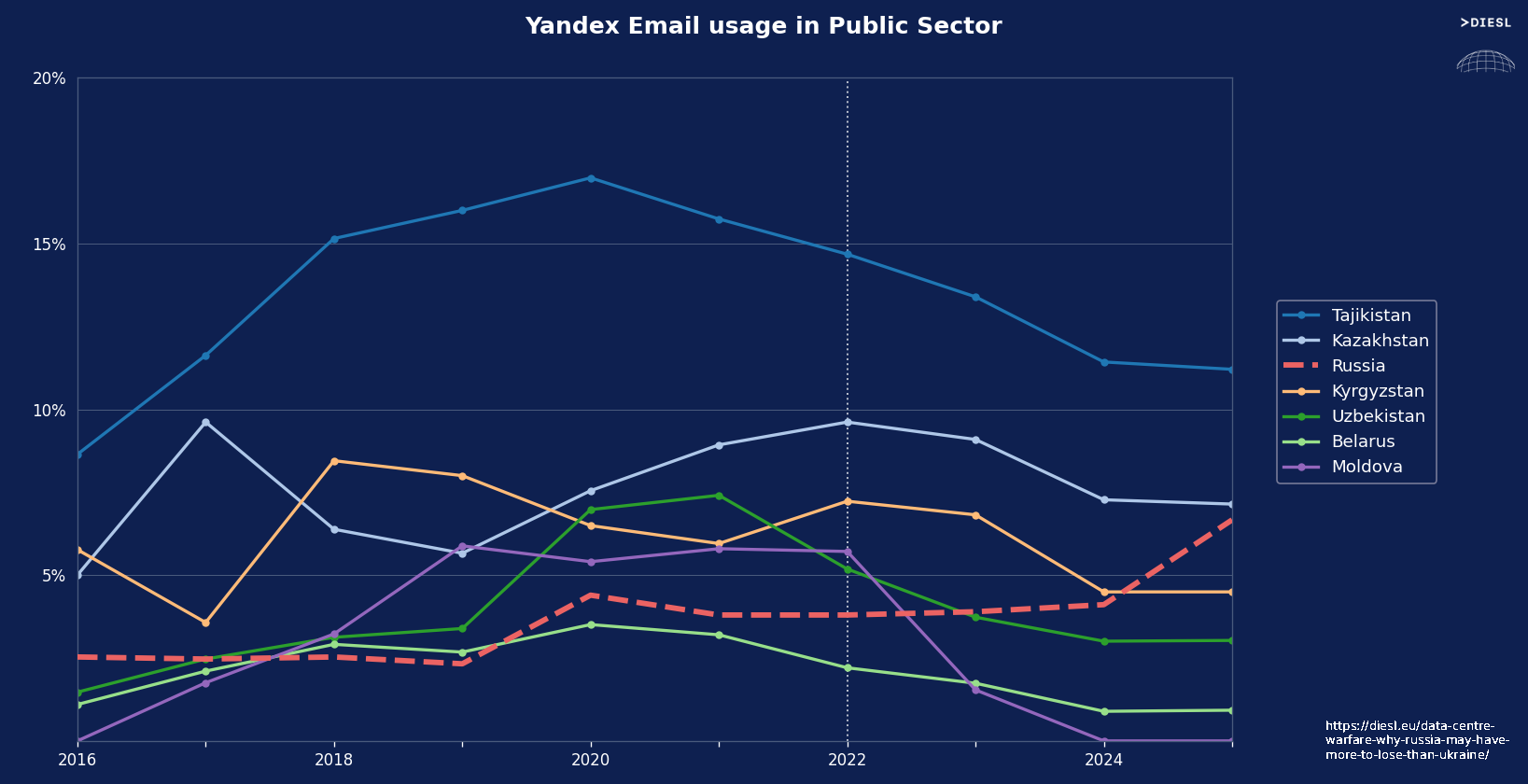
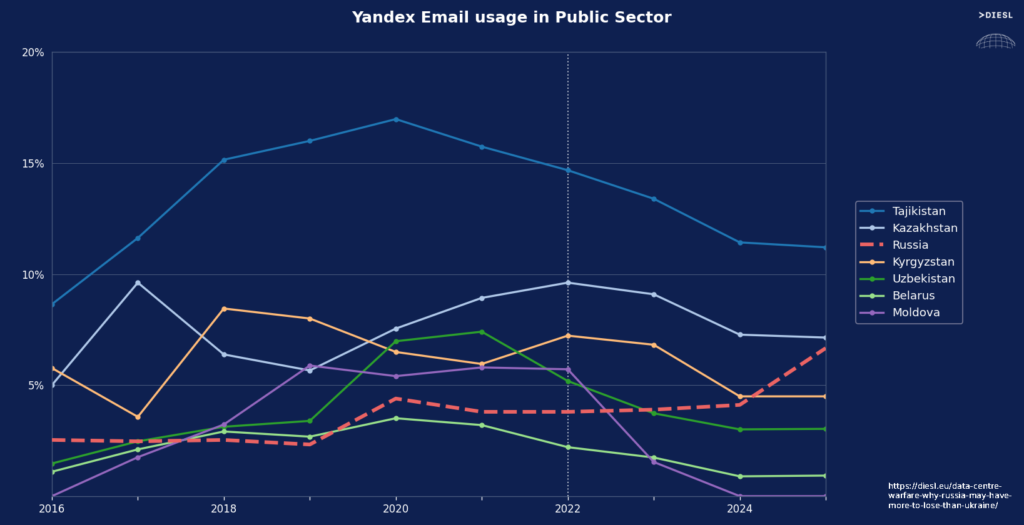
- Yandex’s outages reach beyond Russia. Our data suggest that public- and private-sector organisations in Central Asia, Belarus and Moldova use Yandex mail and DNS services. Since 2022, Yandex adoption appears to have fallen in every country we tracked except Russia.
- Only about 5% of Russian public-sector domains appear to depend directly on Yandex. Where the Russian state’s own digital infrastructure is located, including any reliance on Chinese cloud, remains an open question.
Asymmetric exposure
For Ukraine, internet connectivity matters in several ways. Remote work is a source of export income, and working from home keeps local firms running under bombardment. Connectivity also carries communication between government and citizens, keeps soldiers in contact with their families, and is reportedly used for some tactical communications. Russian strikes on Ukrainian data centres and telecommunications sites therefore have real costs. However, Ukraine’s most critical state data is relatively insulated. In the first months of the full-scale invasion, the government carried out an emergency migration of core systems to US cloud providers, and the country’s largest bank reportedly did the same.
Russia is in a different position. Data localisation laws require companies to store Russians’ personal data on servers inside the country. Sanctions have since made foreign-hosted services hard to use. Together, these policies have given Yandex and a handful of other firms a captive market. Yandex supplies everything from search, maps and email to file storage, payments, ride-hailing, AI assistants and cloud hosting for more than 50,000 businesses. Its data centres have consequently become large single points of failure. When the strikes halted Yandex’s data centres in Sasovo and Vladimir and destroyed several modules at its Kaluga site, the effects spread across Russia’s digital economy, from Sberbank’s AI assistant to the property portal Cian and the website of St Petersburg’s Pulkovo airport.
Russia is not short of data centre capacity. According to the national grid operator, it amounts to 4.2 GW. But a large share of that capacity is crypto mining, which cannot host government or financial services. Yandex did shift some workloads to VK Cloud, Selectel and K2Cloud, which shows that some redundancy exists. However, Kommersant estimates that replacing the damaged equipment will take around six months, at a time when hardware prices are at record highs. Some capacity reportedly will not be restored at all. In that sense, Russia is probably more vulnerable to data centre warfare than Ukraine is.
Collateral damage abroad
The outages did not stop at Russia’s borders. Taxi and food delivery apps failed in Kyrgyzstan, Kazakhstan and Uzbekistan, and similar problems were reported in Armenia, Belarus and Serbia. Our analysis of DNS mail records suggests that institutional use of Yandex is also significant. As of 2025, roughly 11% of public-sector domains in Tajikistan and around 7% in Kazakhstan appear to use Yandex for email, as do about 6.5% of private-sector domains in Belarus and 5% in Uzbekistan. Yandex’s mail is bundled with its office suite, so the affected organisations may lose access to files and calendars as well as email.
Since 2022, Yandex adoption appears to have fallen in every country we tracked, in both the public and private sectors, while in Russia it has risen. The Russian market seems to be turning inward just as its neighbours diversify away from it.
Geopolitical implications
Data centre strikes are not confined to this war. In March, Iranian drones damaged AWS data centres in the UAE and Bahrain. Six months later, Amazon told customers that some of the data it had hosted in the UAE could not be restored. As we argued at the time, AI and cloud facilities are increasingly treated as dual-use infrastructure. The Yandex sites that were hit also house three of the company’s AI supercomputers.
For digitalised societies and militaries, data centres are strategic assets that need to be defended. Defence may be kinetic: Russian operators are reportedly already buying anti-drone equipment, and underground facilities may become more attractive. It also involves decisions about location, including placing government backups or live workloads abroad, as Ukraine did. That requires allies one can trust.
Market forces are shaping the geography of computation too. As workloads shift towards cooler climates, countries may acquire a strategic interest in the security of places like the Nordics simply because so much of their private-sector computing now runs there.
Where is the Russian state’s data?
Surprisingly, our data suggest that only about 5% of Russian public-sector domains in our sample depend directly on Yandex for content delivery or email services. One of them is dobro.ru, the national volunteering platform, which is currently down with an error page. Some dependencies may be hidden behind intermediaries. Still, the Russian state’s critical systems appear to be hosted largely elsewhere, whether in government-run facilities, with state-linked operators or abroad. How far does Russia now rely on Chinese cloud, and with what geopolitical consequences? We hope to address these questions in a future update from the GEOCLOUD research project.
Vili Lehdonvirta is Professor of Technology Policy at Aalto University, where he leads the ERC-funded GEOCLOUD project on the geopolitics and geoeconomics of digital infrastructure.
Kaarlo Liukkonen is a doctoral researcher at Aalto University whose research examines countries’ diverging digital dependencies from a structural-economic point of view.
Jaakko Kilpi is a doctoral researcher at Aalto University who uses computational methods to study how states depend on foreign cloud infrastructure.
Further reading: Ryan Mac and Ivan Nechepurenko, “To Inflict Economic Pain, Russia and Ukraine Strike at Data Centers”, New York Times, 15 October 2026; Meduza, “Ukraine knocked out key Yandex data centers”, 12 October 2026; Vili Lehdonvirta, “Drone strikes on Gulf data centres: How geopolitics will shape the fallout“, DIESL, 9 March 2026.