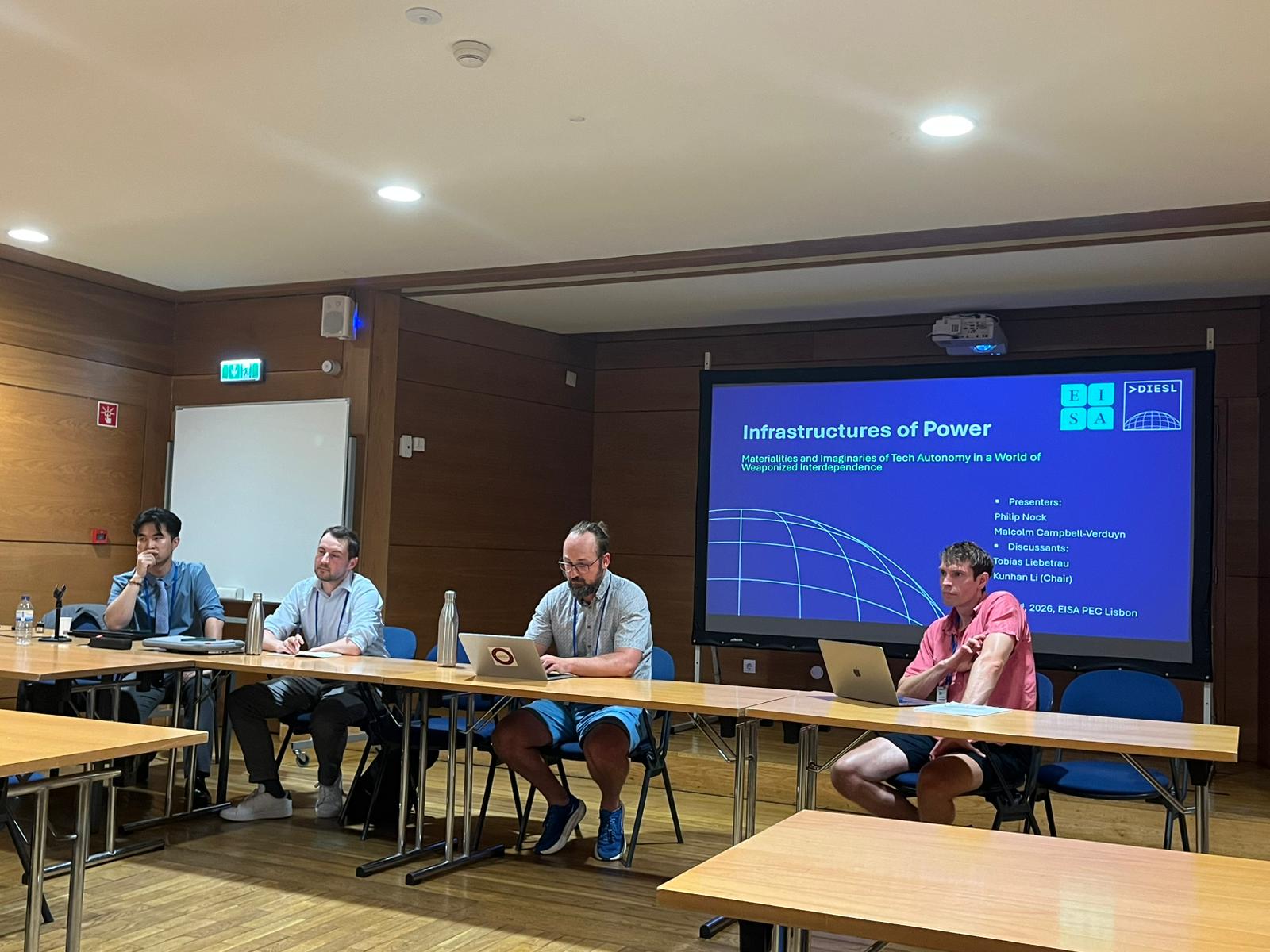
DIESL member Kunhan Li organised and chaired the panel “Infrastructures of Power: Materialities and Imaginaries of Tech Autonomy in a World of Weaponized Interdependence” at the 19th Pan-European Conference on International Relations (EISA PEC 2026), hosted by Iscte – University Institute of Lisbon on 1–4 September. The session paired work on the material foundations of technological autonomy with work on the competing meanings that public and private actors attach to sovereignty.
Philip Nock (University of Bonn) presented research on European dependencies in global semiconductor production networks. Bringing together three datasets on digital dependence, global electronics production and semiconductor supply chains, the paper sets out Europe’s position in the sector before the COVID-19 pandemic and maps European investment initiatives between 2018 and 2024, tracing how public-private partnerships intensified after the chip shortage. Nock argued that these policies and financial instruments operate as instruments of geoeconomic power, and that they are likely to reduce Europe’s dependencies rather than remove them, which sets a limit on what strategic autonomy in high technology can mean.
Malcolm Campbell-Verduyn (University of Groningen) presented a paper co-authored with G. Beaumier (École nationale d’administration publique) and M. Quitin (Université Laval) on the contest over what digital sovereignty means in practice. The paper reads competing sovereignty claims as socio-technical imaginaries and maps them along two axes, the locus of authority and the scale at which sovereignty is imagined. On this account, Big Tech’s “sovereignty-as-a-service” offerings advance a technocentric conception anchored in computing capacity and infrastructure, one that sits awkwardly beside other claims. The authors suggest that digital sovereignty works less as a shared concept than as a contested field of projects with incompatible assumptions.
Tobias Liebetrau (University of Copenhagen) joined the panel as discussant. The session closed with a roundtable on the overarching question from the call for papers and an open discussion with the audience.
Philip Nock (University of Bonn) and Malcolm Campbell-Verduyn (University of Groningen) presented their work in progress papers, with Tobias Liebetrau (University of Copenhagen) joining as discussant. The session closed with a discussion on the overarching question set out in the call for papers, followed by an open discussion with the audience.
The panel connected DIESL’s research on digital infrastructure and economic security with current debates in International Relations, International Political Economy, and drew an audience working across different fields.